Florida's Still-Missing Shipwrecks, and Why Other Countries Claim the Treasure When It's Found
A public, expanded version of a newsletter article.
Every few years a storm stirs up the sand off Florida's Atlantic coast and somebody finds a silver coin on the beach. Some of the ships those coins came from have never been found. And when a Spanish ship is found, the people who found it often aren't the ones who get to keep it.
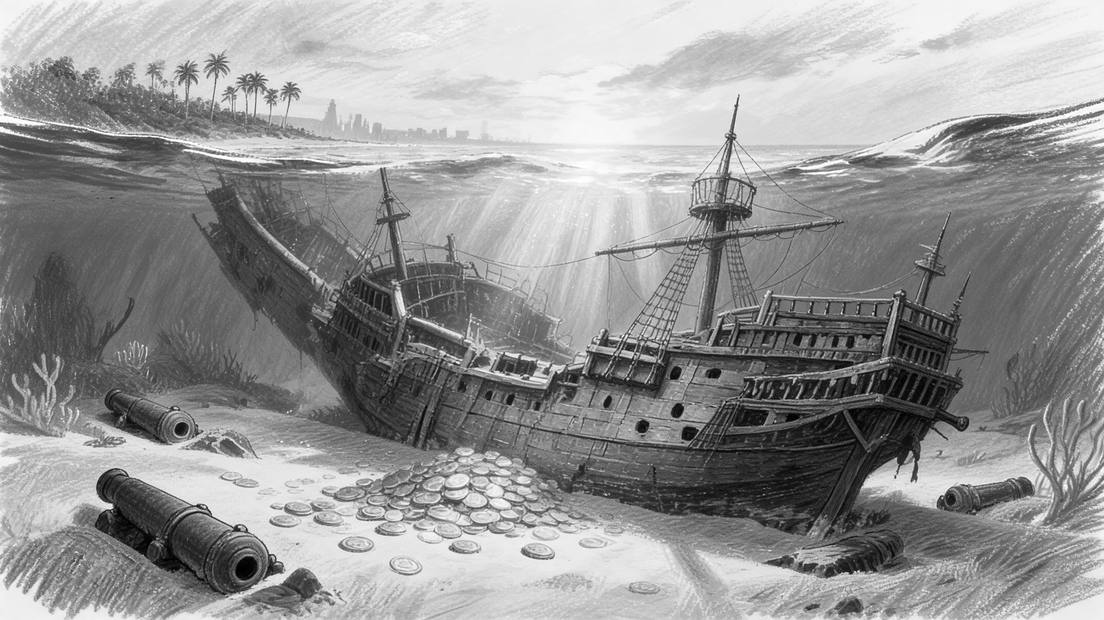
Why it's called the Treasure Coast
On July 31, 1715, a hurricane wrecked a Spanish plate fleet carrying New World wealth home from Havana. The wrecks lie between the St. Lucie River and Cape Canaveral (Florida Memory). After a 1955 hurricane uncovered signs of the wrecks near Sebastian Inlet, local man Kip Wagner took up the search and formed a company, Real Eight, that found fleet ships and a large haul of artifacts (Florida Memory, 1715 Fleet Society).
The name came after that. Vero Beach Press Journal publisher John J. Schumann Jr. and editor Harry J. Schultz are usually credited with coining "Treasure Coast" in the 1960s. They reasoned that the Gold Coast lay to the south and the Space Coast to the north, so their stretch should be the Treasure Coast (Florida Memory, WQCS, 2011). Even that credit isn't certain. A local history librarian told Indian River Magazine "there's no definitive source saying who named it," and Schumann himself said he "thinks" they popularized it (Indian River Magazine, WQCS).
Privateers, pirates and this coast
Before the United States had much of a navy, it leaned on privateers, privately owned armed ships licensed to raid enemy shipping. In the Revolution, nearly 800 American vessels were commissioned as privateers and are credited with capturing or destroying about 600 British ships (National Park Service). In the War of 1812, 517 privateers took or destroyed about 1,300 prizes, against 254 for a 23-ship Navy (Hill, 1910, via ibiblio%20(1910).pdf)).
But be careful connecting those American privateers to the Treasure Coast. Florida was Spanish or British during those wars, and we found no source showing American privateers working this particular coast. The privateer story that really is tied to the Treasure Coast is older and British. In late 1715, Jamaica's governor commissioned privateers, Henry Jennings among them, to hunt pirates. Instead, in early 1716, they landed near the 1715 wrecks, drove off the guards at the Spanish salvage camp, and carried away roughly 120,000 pieces of eight (Cambridge University Press, Sailing the Black Flag, quoting depositions). Historians link that raid, and the wreck-hunting craze after it, to the rise of the pirate base in the Bahamas (Cambridge). So the privateers did come, but the main reason the treasure is here is the 1715 hurricane.
The ships nobody has found
1715 Fleet. All but one of the fleet's ships sank, and modern salvors have worked several of the sites ever since (Florida Memory). The 1715 Fleet Society, a research group, says two ships the Spanish salvaged in 1715 to 1718 were never found in modern times, and at least two others were lost at sea with everyone aboard. It names the El Señor San Miguel and a captured French ship called El Ciervo (1715 Fleet Society). Exactly which named ship lies at which known site is still argued. Some researchers say the "Douglass Beach" wreck isn't the Nieves at all, which would leave the real Nieves undiscovered (1715 Fleet Society, Dark Tide Relics). Uncertain: lists of "missing" 1715 ships differ from source to source.
1733 Fleet. A 1733 hurricane wrecked the New Spain fleet in the Keys. Keys Weekly reports that two of its ships, the San Fernando and the El Floridana, are still unidentified. Coins have turned up in the Middle Keys, but no remains of either ship have been recorded (Keys Weekly). The state's 1733 Spanish Galleon Trail covers the sites that have been found (Florida Division of Historical Resources).
Who owns a wreck once it's found?
- State waters. Florida law covers historic sites on state-owned land and on the bottom of state waters, which reach 3 miles out in the Atlantic and 9 miles in the Gulf. Disturbing those sites or taking anything from them without written permission from the Division of Historical Resources is illegal, and digging without a permit is a third-degree felony (Florida DHR, DHR FAQ).
- Abandoned Shipwreck Act (1987). This federal law gives states title to abandoned shipwrecks embedded in their submerged lands. The Sea Hunt court noted that Virginia used it to claim two Spanish wrecks (Sea Hunt, 4th Cir. 2000, 43 U.S.C. ch. 39).
- Sunken Military Craft Act (2004). A foreign country keeps title to its sunken warships unless it expressly gives them up. Time alone doesn't end that title (Naval History and Heritage Command).
- Outside state waters, federal admiralty courts decide salvage claims. That's how Mel Fisher's company fought over the Atocha, a 1622 galleon found in 1971 about 9.5 nautical miles west of the Marquesas Keys. The Fifth Circuit held that the finders, not the United States, had title, and the Supreme Court let the finders recover artifacts held by Florida officials (Justia, 458 U.S. 670, 621 F.2d 1340). Unlike the cases below, Atocha was a merchant galleon, and Spain made no claim to it.
When other countries say "that's ours"
- La Galga and Juno (2000). Sea Hunt found two Spanish navy ships off Virginia, lost in 1750 and 1802. Under a 1902 U.S.–Spain treaty, those ships could only be abandoned by an express act, and the court found none. "Both vessels remain the property of Spain," the court ruled, and Sea Hunt got no salvage award (Sea Hunt, 221 F.3d 634).
- The Mercedes (2011–2012). Odyssey Marine, a Tampa company, recovered coins in 2007 from a wreck in international waters near Gibraltar and filed its claim in a Florida federal court. The court found the wreck was the Spanish warship Mercedes and immune from seizure. Peru's claim, based on the coins being mined and minted in Peru, was rejected (11th Cir. opinion, BBC). Spanish military planes flew about 594,000 coins home in February 2012 (Reuters, Spain's Ministry of Culture).
- The San José (off Colombia). This is not a Florida wreck, but it shows how crowded these fights get. A U.S. company, Sea Search-Armada, is in arbitration with Colombia over a claimed share (arbitration filing). Spain asserts rights to its navy ship (Kluwer Arbitration Blog). Bolivia's Qhara Qhara Indigenous people say the silver came from Potosí (Reuters, 2024).
- UNESCO's 2001 underwater heritage treaty favors leaving wrecks in place, but the United States has not joined it (UNESCO states parties).
If you find something
- Don't disturb it. Take photos and note the location (Florida DHR).
- Report it to the State Underwater Archaeologist, Bureau of Archaeological Research, 850-245-6444 (Florida DHR).
- Metal detecting is generally banned on state land. Many public beaches allow it between the high-tide line and the toe of the dune. In coastal state parks it's allowed only on beach areas the park manager designates, never underwater, and you can't keep anything over 50 years old (DHR FAQ, Florida State Parks).
Coming soon: ASA Digital Art's field guide to Florida gems and minerals, "Sunken Treasure of the Sunshine State."
This is general information, not legal advice. Rules depend on exactly where you are. Ask the Division of Historical Resources or a lawyer before you dig, dive or keep anything.
Sources
Every fact above comes from one of these sources, read Oct 20, 2026.
- Florida Memory: https://www.floridamemory.com/items/show/295242
- WQCS, 2011: https://www.wqcs.org/wqcs-special-programs/2011-04-04/we-call-our-area-the-treasure-coast-but-it-has-not-always-been-that-way-as-paul-janensch-reports-in-this-treasure-coast-essay
- Indian River Magazine: https://indianrivermagazine.com/how-we-became-the-treasure-coast/
- 1715 Fleet Society: https://1715fleetsociety.com/history/
- Dark Tide Relics: https://darktiderelics.com/research/reports/the-1715-fleet-real-eight-to-present-day
- Keys Weekly: https://keysweekly.com/42/keys-history-lost-wrecks-of-the-1733-new-spain-fleet/
- FL DHR 1733 Galleon Trail: https://info.flheritage.com/galleon-trail/fleetOf1733.cfm
- National Park Service: https://home.nps.gov/articles/privateers-in-the-american-revolution.htm
- Hill, The Romance of the American Navy (1910): http://www.ibiblio.org/pha/USN/Navy/Romance%20of%20the%20American%20Navy,%20Twenty-Six%20Historic%20Ships%20(Hill)%20(1910).pdf
- Cambridge UP, Suppressing Piracy, ch. 1: https://www.cambridge.org/core/books/abs/suppressing-piracy-in-the-early-eighteenth-century/peacetime-disputes-and-the-rise-of-piracy/E3EF35EB27D73AE301310916A2B96136
- Sailing the Black Flag: https://sailingtheblackflag.com/people/henry-jennings/
- FL DHR laws: https://dos.fl.gov/historical/archaeology/underwater/laws
- FL DHR FAQs: https://dos.fl.gov/historical/archaeology/underwater/faq/ and https://dos.fl.gov/historical/archaeology/archaeology-faqs
- FL DHR participation: https://dos.fl.gov/historical/archaeology/underwater/participation
- Florida State Parks FAQ: https://www.floridastateparks.org/plan-your-visit/faqs?f=question_type%3A356
- 43 U.S.C. ch. 39: https://www.govinfo.gov/content/pkg/USCODE-2024-title43/html/USCODE-2024-title43-chap39.htm
- NHHC, Sunken Military Craft Act: https://www.history.navy.mil/research/underwater-archaeology/policy-and-resource-management/sunken-military-craft-act/smca.html
- Sea Hunt v. Unidentified Shipwrecked Vessel, 221 F.3d 634: https://law.resource.org/pub/us/case/reporter/F3/221/221.F3d.634.-98-281-2.99-2036.99-2035.html
- Florida Dept. of State v. Treasure Salvors, 458 U.S. 670: https://supreme.justia.com/cases/federal/us/458/670/
- Treasure Salvors, 621 F.2d 1340: https://law.resource.org/pub/us/case/reporter/F2/621/621.F2d.1340.78-2950.html
- Odyssey v. Unidentified Shipwrecked Vessel (11th Cir. 2011): https://media.ca11.uscourts.gov/opinions/pub/files/201010269.pdf
- BBC, 2012: https://www.bbc.com/news/world-us-canada-17158436
- Reuters, 2012: https://www.reuters.com/article/lifestyle/science/spanish-treasure-lands-after-200-years-idUSTRE81O0P6/
- Spain Ministry of Culture: https://www.cultura.gob.es/fragatamercedes/litigio/regreso-bienes-culturales.html
- Sea Search-Armada arbitration filing: https://arbitration.org/sites/default/files/awards/arb10061.pdf
- Kluwer Arbitration Blog: https://legalblogs.wolterskluwer.com/arbitration-blog/seeking-a-treasure-behavioral-economics-in-the-sea-search-armada-v-colombia-arbitration/
- Reuters, 2024: https://www.reuters.com/world/americas/indigenous-groups-claim-stake-sunken-spanish-ship-cargo-off-colombia-2024-05-10/
- UNESCO states parties: https://www.unesco.org/en/underwater-heritage/states-parties
Drafted Oct 20, 2026 for Issue 1003. Not legal advice. Spotted an error? Email asadigitalart000@gmail.com and we will fix it.
Comments and threads
Comments earn store credit. Every comment we approve earns 10 store credits (worth $1.00 in the shop), whatever it says: positive, negative or neutral. We do not ask for or pay for positive comments or reviews. Limits: 100 credits a day and 1,000 credits a month ($100.00) per account. Credits have no cash value, cannot be cashed out or transferred, and expire after 12 months. Comments are reviewed before they appear; we approve or reject on the comment rules only. One account per person. Credit is shown in your account once approved and applied by hand to a shop order or membership month.
Loading comments…